
The Report
Samples
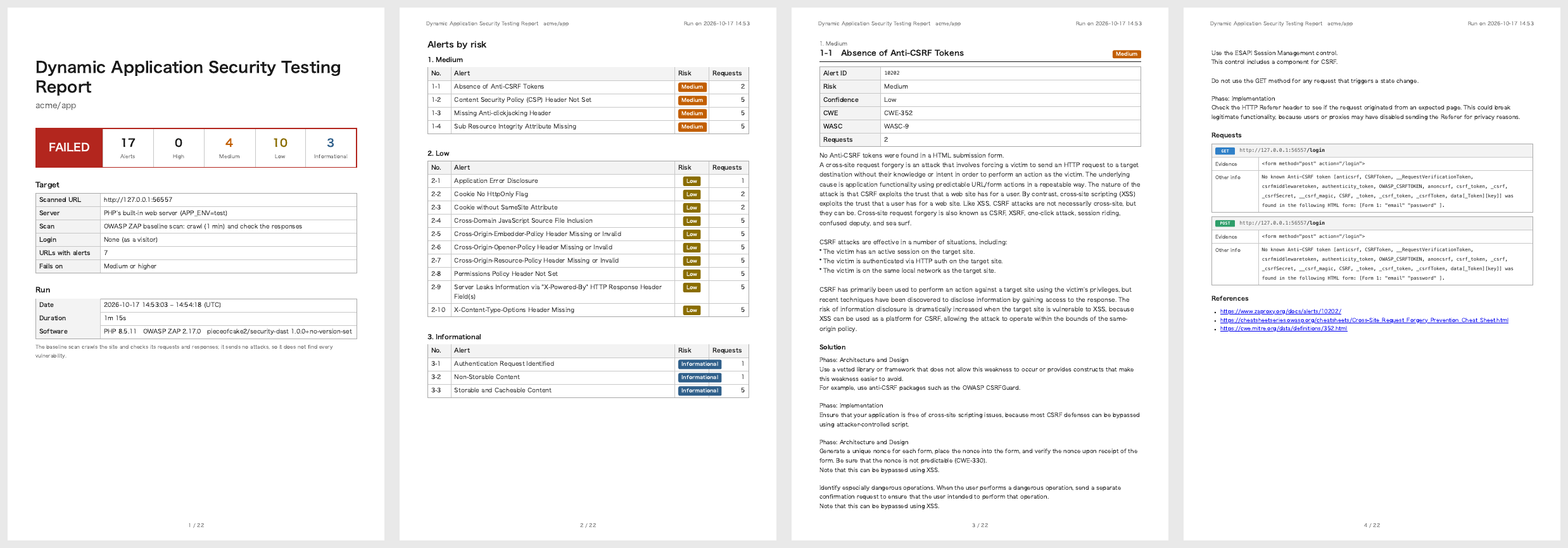
The baseline scan of a page without the security headers, with a form without a token and an error page:
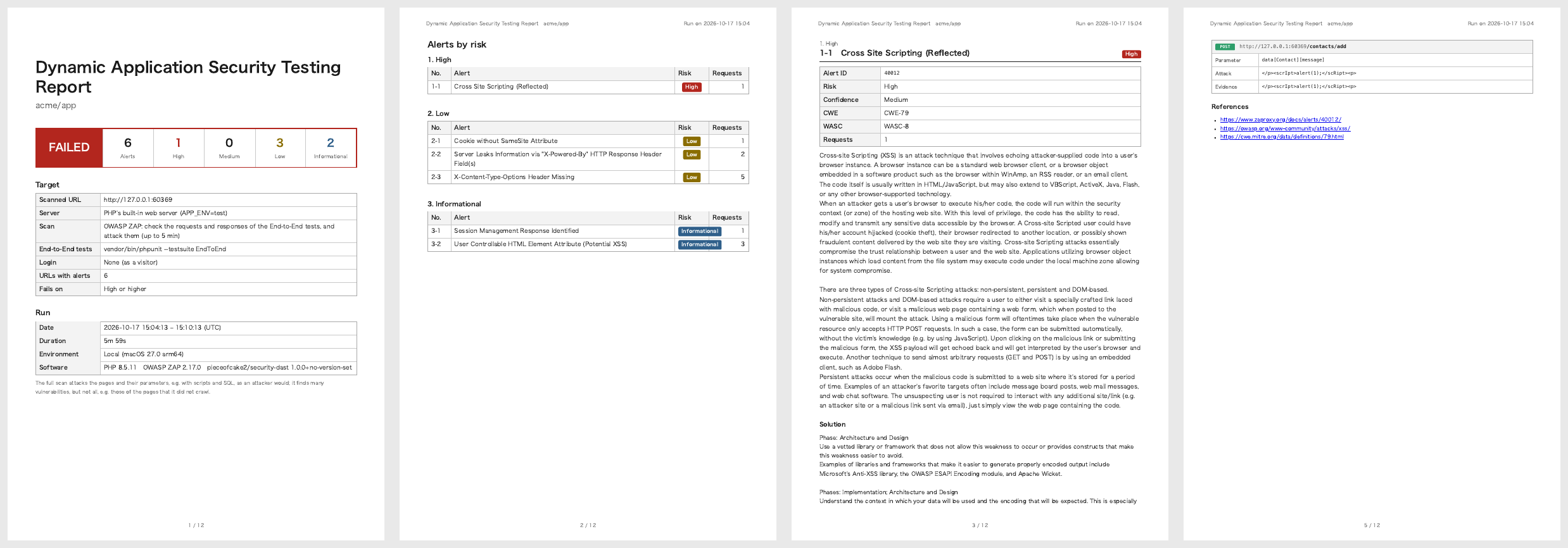
The full scan of a CakePHP 2 application, with an End-to-End test as the scenario: a form of SecurityComponent that prints its value without h(), found as a reflected XSS:
The Pages
- Cover: the result, the numbers of alerts by risk, the repository, branch and commit, and what was scanned: the URL, the server (the built-in web server and its
APP_ENV, or a running application), the scan (baseline or full, its minutes), the End-to-End tests and their result, the user of the login, the number of URLs with alerts, the ignored alerts and the threshold; then the date, environment and software of the run (ZAP and its version) - Alerts by risk: High, Medium, Low and Informational; each alert with its number of requests, and a link to its page
- A page for each alert: its name, alert ID, risk, confidence, CWE and WASC, what it means and how to fix it (as ZAP writes them, in the language of the report), each request where it was found, up to 50, and the links: the page of the alert on zaproxy.org first
Each request shows its method and URL, then what ZAP found in it:
| Parameter | The parameter, header or cookie of the alert, e.g. data[Contact][message] |
| Attack | The value that ZAP sent, for the alerts of the full scan |
| Evidence | What the response showed, e.g. the attack printed as it was sent, or the header that is missing |
| Other info | More details of ZAP |
See Alerts for the fixes of the alerts in a CakePHP 2 application.
Risk and Confidence
The risk is how bad the issue is when it is real: High (e.g. XSS, SQL injection), Medium (e.g. a missing CSP or anti-clickjacking header), Low (e.g. a cookie without SameSite), and Informational (to know, rarely to fix). The confidence is how sure ZAP is that the issue is real: Low, Medium, High or Confirmed. Check an alert of low confidence in the code before fixing it: it can be a false positive.
--fail-on fails the run on a risk, whatever the confidence:
--fail-on | Fails on |
|---|---|
high (default) | High |
medium | High and Medium |
low | High, Medium and Low |
info | Every alert |
none | Nothing: the report only |
For an existing application, start with --fail-on=none, fix the alerts of the report, then raise the threshold.
Ignoring an Alert
Fix the alerts first: most of them are fixed once for the whole application, in AppController or the web server (Alerts). When an alert does not apply, leave it out of the report with its ID:
vendor/bin/security-dast --ignore=10038,10020- An ID leaves out its variants too:
10038leaves out10038-1. - The IDs are those of the report (Alert ID) and of the alerts of ZAP.
- The cover of the report lists the ignored alerts, so that they are not forgotten.
The alerts to ignore are those of the scan environment, not of the application: e.g. the security headers that a proxy in front of production adds, which the built-in web server of the scan does not have, or the X-Powered-By of the PHP of CI. Keep the reason in the settings file:
'dast' => [
    // The load balancer of production adds CSP and X-Frame-Options; checked on staging with --url
    'ignore' => ['10038', '10020'],
],