
Continuous Integration
Continuous integration (CI) runs your checks on every push and pull request, so that a broken test, a coding standard violation or a type error is found before the change is merged. This page shows a GitHub Actions workflow for an application built on the pieceofcake2/app skeleton, introduces each of its jobs with a link to the page that covers the tool in detail, and shows how to add a short summary of each job to the run page. Running the tests on a Jenkins server is described at the end, in Jenkins.
What to Run
A CakePHP 2 application usually runs these jobs:
| Job | Tool | What it checks | Details |
|---|---|---|---|
| PHPUnit | vendor/bin/phpunit | Unit tests and integration tests, on each supported PHP version | Testing, Integration Testing |
| Coding standard | vendor/bin/phpcs | The CakePHP coding standard | Coding Standards |
| PHPStan | vendor/bin/phpstan | Bugs found without running the code | Static Analysis |
| E2E | vendor/bin/phpunit -c phpunit.e2e.xml.dist | Pages in a real browser | E2E Testing |
The pieceofcake2/app skeleton already includes the configuration for the first three: phpunit.xml.dist, phpcs.xml and phpstan.neon, with PHPUnit, the CakePHP codesniffer, PHPStan and pieceofcake2/phpstan-cakephp2 as development dependencies. E2E tests need pieceofcake2/e2e-test and a little setup; add that job when you have E2E tests.
A GitHub Actions Workflow
Save the workflow as .github/workflows/ci.yml. It runs the four jobs in parallel:
# .github/workflows/ci.yml
name: CI

on:
  push:
    branches:
      - main
  pull_request:

concurrency:
  group: ${{ github.workflow }}-${{ github.ref }}
  cancel-in-progress: true

permissions:
  contents: read

env:
  # Test values. The real salts are not in the repository (config/.env is ignored by git).
  SECURITY_SALT: ci-salt-for-tests-only-0123456789abcdef
  SECURITY_CIPHER_SEED: '1234567890'

jobs:
  phpunit:
    name: PHPUnit (PHP ${{ matrix.php-version }})
    runs-on: ubuntu-latest

    strategy:
      fail-fast: false
      matrix:
        php-version: ['8.0', '8.1', '8.2', '8.3', '8.4', '8.5']

    services:
      mysql:
        image: mysql:8.0
        env:
          MYSQL_ROOT_PASSWORD: root
          MYSQL_DATABASE: cakephp_test
        ports:
          - 3306:3306
        options: >-
          --health-cmd="mysqladmin ping"
          --health-interval=10s
          --health-timeout=5s
          --health-retries=5

    env:
      DB_TEST_DATASOURCE: Database/Mysql
      DB_TEST_HOST: 127.0.0.1
      DB_TEST_PORT: 3306
      DB_TEST_USERNAME: root
      DB_TEST_PASSWORD: root
      DB_TEST_DATABASE: cakephp_test

    steps:
      - uses: actions/checkout@v7
        with:
          persist-credentials: false

      - name: Setup PHP
        uses: shivammathur/setup-php@v2
        with:
          php-version: ${{ matrix.php-version }}
          extensions: mbstring, intl, pdo_mysql
          coverage: pcov

      - name: Get Composer cache directory
        id: composer-cache
        run: echo "dir=$(composer config cache-files-dir)" >> "$GITHUB_OUTPUT"

      - name: Cache Composer packages
        uses: actions/cache@v6
        with:
          path: ${{ steps.composer-cache.outputs.dir }}
          key: ${{ runner.os }}-php${{ matrix.php-version }}-composer-${{ hashFiles('composer.lock') }}
          restore-keys: |
            ${{ runner.os }}-php${{ matrix.php-version }}-composer-

      - name: Install Composer packages
        run: composer install --no-interaction --no-progress

      - name: Create config/database.php
        run: cp config/database.php.default config/database.php

      - name: Setup problem matchers for PHPUnit
        run: echo "::add-matcher::${{ runner.tool_cache }}/phpunit.json"

      - name: Run PHPUnit
        run: vendor/bin/phpunit --log-junit junit.xml --coverage-clover coverage.xml

  phpcs:
    name: Coding standard
    runs-on: ubuntu-latest

    steps:
      - uses: actions/checkout@v7
        with:
          persist-credentials: false

      - name: Setup PHP
        uses: shivammathur/setup-php@v2
        with:
          php-version: '8.4'
          extensions: mbstring, intl
          coverage: none
          tools: cs2pr

      - name: Get Composer cache directory
        id: composer-cache
        run: echo "dir=$(composer config cache-files-dir)" >> "$GITHUB_OUTPUT"

      - name: Cache Composer packages
        uses: actions/cache@v6
        with:
          path: ${{ steps.composer-cache.outputs.dir }}
          key: ${{ runner.os }}-php8.4-composer-${{ hashFiles('composer.lock') }}
          restore-keys: |
            ${{ runner.os }}-php8.4-composer-

      - name: Install Composer packages
        run: composer install --no-interaction --no-progress

      - name: Check the coding standard
        id: phpcs
        run: vendor/bin/phpcs --report-full --report-checkstyle=phpcs-report.xml

      - name: Annotate the pull request
        if: ${{ always() && steps.phpcs.outcome == 'failure' }}
        run: cs2pr phpcs-report.xml

  phpstan:
    name: PHPStan
    runs-on: ubuntu-latest

    steps:
      - uses: actions/checkout@v7
        with:
          persist-credentials: false

      - name: Setup PHP
        uses: shivammathur/setup-php@v2
        with:
          php-version: '8.4'
          extensions: mbstring, intl
          coverage: none
          tools: cs2pr

      - name: Get Composer cache directory
        id: composer-cache
        run: echo "dir=$(composer config cache-files-dir)" >> "$GITHUB_OUTPUT"

      - name: Cache Composer packages
        uses: actions/cache@v6
        with:
          path: ${{ steps.composer-cache.outputs.dir }}
          key: ${{ runner.os }}-php8.4-composer-${{ hashFiles('composer.lock') }}
          restore-keys: |
            ${{ runner.os }}-php8.4-composer-

      - name: Install Composer packages
        run: composer install --no-interaction --no-progress

      - name: Run PHPStan
        id: phpstan
        run: vendor/bin/phpstan analyse --no-progress --error-format=checkstyle > phpstan-report.xml

      - name: Annotate the pull request
        if: ${{ always() && steps.phpstan.outcome == 'failure' }}
        run: cs2pr phpstan-report.xml

  e2e:
    name: E2E
    runs-on: ubuntu-latest

    services:
      mysql:
        image: mysql:8.0
        env:
          MYSQL_ROOT_PASSWORD: root
          MYSQL_DATABASE: cakephp_test
        ports:
          - 3306:3306
        options: >-
          --health-cmd="mysqladmin ping"
          --health-interval=10s
          --health-timeout=5s
          --health-retries=5

    env:
      DB_TEST_DATASOURCE: Database/Mysql
      DB_TEST_HOST: 127.0.0.1
      DB_TEST_PORT: 3306
      DB_TEST_USERNAME: root
      DB_TEST_PASSWORD: root
      DB_TEST_DATABASE: cakephp_test

    steps:
      - uses: actions/checkout@v7
        with:
          persist-credentials: false

      - name: Setup PHP
        uses: shivammathur/setup-php@v2
        with:
          php-version: '8.4'
          extensions: mbstring, intl, pdo_mysql
          coverage: none

      - name: Get Composer cache directory
        id: composer-cache
        run: echo "dir=$(composer config cache-files-dir)" >> "$GITHUB_OUTPUT"

      - name: Cache Composer packages
        uses: actions/cache@v6
        with:
          path: ${{ steps.composer-cache.outputs.dir }}
          key: ${{ runner.os }}-php8.4-composer-${{ hashFiles('composer.lock') }}
          restore-keys: |
            ${{ runner.os }}-php8.4-composer-

      - name: Install Composer packages
        run: composer install --no-interaction --no-progress

      - name: Create config/database.php
        run: cp config/database.php.default config/database.php

      # Chrome for Testing and the matching chromedriver
      - name: Setup Chrome
        id: setup-chrome
        uses: browser-actions/setup-chrome@v2
        with:
          chrome-version: stable
          install-chromedriver: true

      - name: Run E2E tests
        env:
          PANTHER_CHROME_BINARY: ${{ steps.setup-chrome.outputs.chrome-path }}
          PANTHER_CHROME_DRIVER_BINARY: ${{ steps.setup-chrome.outputs.chromedriver-path }}
          PANTHER_NO_SANDBOX: 1
        run: vendor/bin/phpunit -c phpunit.e2e.xml.dist

      # Screenshots, HTML and server logs of the failed tests
      - name: Upload E2E artifacts
        if: ${{ failure() }}
        uses: actions/upload-artifact@v7
        with:
          name: e2e-artifacts
          path: tests/E2E/artifacts/
          retention-days: 7
if-no-files-found: ignoreThe parts that every job shares:
- PHP. setup-php installs PHP with the extensions the application needs:
mbstringandintl, and the PDO driver of your database (pdo_mysql,pdo_pgsql,pdo_sqliteorpdo_sqlsrv). Add the extensions of your cache engines, such asapcuorredis, if the tests use them. The PHPUnit job runs on every PHP version in its matrix; the other jobs need only one version. - Composer. The cache steps keep the downloaded packages between runs, keyed by the PHP version and
composer.lock. Commitcomposer.lock. A lock file must install on every PHP version of the matrix, so setconfig.platform.phpincomposer.jsonto the lowest one (for example"8.0.30") if you update the packages on a newer PHP. - Database. The jobs that use the database start MySQL as a service container.
config/database.phpis not committed in the skeleton, so the job copiesconfig/database.php.default, which reads thetestconnection from theDB_TEST_*environment variables (see Environment Variables). Fixtures are created in this database, so the tests do not need any tables beforehand. - Salts. The skeleton reads
Security.saltandSecurity.cipherSeedfromSECURITY_SALTandSECURITY_CIPHER_SEED. The workflow sets test values for them; never put your production values in the workflow.
To test with PostgreSQL instead, change the service and the environment variables:
    services:
      postgres:
        image: postgres:17
        env:
          POSTGRES_PASSWORD: postgres
          POSTGRES_DB: cakephp_test
        ports:
          - 5432:5432
        options: >-
          --health-cmd="pg_isready"
          --health-interval=10s
          --health-timeout=5s
          --health-retries=5

    env:
      DB_TEST_DATASOURCE: Database/Postgres
      DB_TEST_HOST: 127.0.0.1
      DB_TEST_PORT: 5432
      DB_TEST_USERNAME: postgres
      DB_TEST_PASSWORD: postgres
DB_TEST_DATABASE: cakephp_testand install pdo_pgsql instead of pdo_mysql. To test both databases, add a db-type axis to the matrix, as the CI of pieceofcake2/app does.
In an application with the legacy app/ layout, the files are in app/ (app/Config/database.php), and the database configuration may not read environment variables; write a database.php for CI in a step instead, as in Jenkins.
The Jobs
PHPUnit
The PHPUnit job runs the tests in tests/TestCase with the skeleton's phpunit.xml.dist, on each PHP version of the matrix. See Testing for writing tests and fixtures, and Test Database Setup for the test connection.
--log-junit junit.xml writes the results in the JUnit XML format, and --coverage-clover coverage.xml writes the code coverage in the Clover format (see Generating code coverage). Coverage needs a coverage driver; coverage: pcov in setup-php installs PCOV. Both files are read by the job summary and by coverage services. If you do not use them, drop the options and set coverage: none, which makes the job faster.
Uploading the coverage is optional. For example, to send it to Codecov, add a step after the tests and the id-token: write permission to the job (OIDC needs no token in the repository):
- name: Upload coverage to Codecov
  uses: codecov/codecov-action@v7
  with:
    use_oidc: true
    files: coverage.xml
flags: php${{ matrix.php-version }}Integration Tests
Integration tests with IntegrationTestTrait are ordinary PHPUnit tests in tests/TestCase/Controller, so the PHPUnit job runs them too. They dispatch requests through your routes with the settings of config/core.php, including the salts that the workflow sets. Emails sent during the tests are captured by EmailTrait and are not delivered. See Integration Testing.
Coding Standard
The coding standard job runs PHP_CodeSniffer with the skeleton's phpcs.xml, which is based on the CakePHP 5 coding standard with exclusions for CakePHP 2 code. --report-full shows the violations in the log, and --report-checkstyle writes them to a file. When the check fails, cs2pr, which setup-php installs with tools: cs2pr, turns the file into annotations on the changed lines of the pull request. Fix most violations locally with vendor/bin/phpcbf. See Coding Standards.
PHPStan
The PHPStan job analyses the code with the skeleton's phpstan.neon, which includes the pieceofcake2/phpstan-cakephp2 extension. --error-format=checkstyle writes the errors in the format that cs2pr reads, and --no-progress keeps the log short. The job needs no database. See Static Analysis for the configuration, the rule level and the baseline.
E2E Tests
The E2E job runs the browser tests of pieceofcake2/e2e-test with their own phpunit.e2e.xml.dist. It needs the database, like the PHPUnit job, and a Chrome that matches its chromedriver, which setup-chrome installs. Run it on one PHP version: it is slower than the other jobs.
When a test fails, the tests save a screenshot, the page HTML and the server logs; the upload step keeps them as an artifact of the run for 7 days. Make its path match the artifactsDir of your E2E bootstrap file. If your build creates CSS or JavaScript files, build them before the E2E tests.
See E2E Testing and the CI section of the e2e-test documentation.
Job Summaries
A failed job shows its errors in the log, between the output of the other steps. The ci-summary action from pieceofcake2/.github turns the report of a job into a job summary, which is shown on the run page:
- Tests (JUnit XML from PHPUnit): the number of tests, assertions, failures and skipped tests, the time and the coverage, and a table of the failed tests with the line in the test and the message. Long messages, such as assertion diffs, are shown in full in a collapsed section.
- Coding standard (checkstyle from phpcs): the number of errors and warnings, and a table with the location, the rule and the message of each.
- PHPStan (checkstyle or JSON): the number of errors, and a table with the location, the identifier and the message of each.
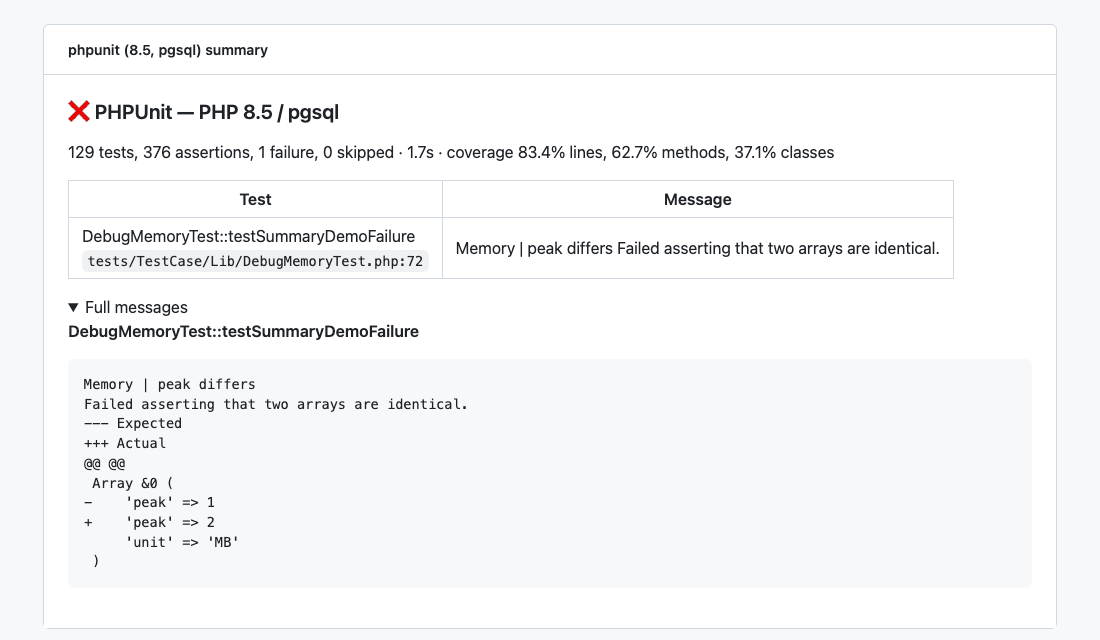
The action needs PHP on the runner, which these jobs already set up. It needs no token and no permissions, and it never fails the job: a missing report ends in a warning. Add it after the step that writes the report, with if: ${{ !cancelled() }}, so that it also runs when that step fails.
PHPUnit
Put the matrix values into the title, so that the summaries of the jobs can be told apart on the run page:
- name: PHPUnit summary
  if: ${{ !cancelled() }}
  uses: pieceofcake2/.github/actions/ci-summary@v1
  with:
    type: junit
    title: PHPUnit — PHP ${{ matrix.php-version }}
    file: junit.xml
coverage: coverage.xmlLeave out coverage if the job does not write a Clover report.
Coding Standard
- name: PHPCS summary
  if: ${{ !cancelled() }}
  uses: pieceofcake2/.github/actions/ci-summary@v1
  with:
    type: checkstyle
    title: PHPCS
file: phpcs-report.xmlThe summary ends with a hint to run vendor/bin/phpcbf. The cs2pr step stays: it adds the annotations to the pull request, and the summary shows the list.
PHPStan
- name: PHPStan summary
  if: ${{ !cancelled() }}
  uses: pieceofcake2/.github/actions/ci-summary@v1
  with:
    type: phpstan
    title: PHPStan
file: phpstan-report.xmlThe action also reads PHPStan's JSON output (--error-format=json).
E2E Tests
Write a JUnit report in the E2E step, and pass the name of the uploaded artifact as artifact-name. When tests failed, the summary adds a line that links to the artifacts of the run, where the screenshots and logs are:
- name: Run E2E tests
  env:
    PANTHER_CHROME_BINARY: ${{ steps.setup-chrome.outputs.chrome-path }}
    PANTHER_CHROME_DRIVER_BINARY: ${{ steps.setup-chrome.outputs.chromedriver-path }}
    PANTHER_NO_SANDBOX: 1
  run: vendor/bin/phpunit -c phpunit.e2e.xml.dist --log-junit e2e-junit.xml

# ... the upload step

- name: E2E summary
  if: ${{ !cancelled() }}
  uses: pieceofcake2/.github/actions/ci-summary@v1
  with:
    type: junit
    title: E2E
    file: e2e-junit.xml
    artifact-name: e2e-artifacts
    artifact-note: Screenshots, page HTML and server logs of the failed tests are in the {artifact} artifact.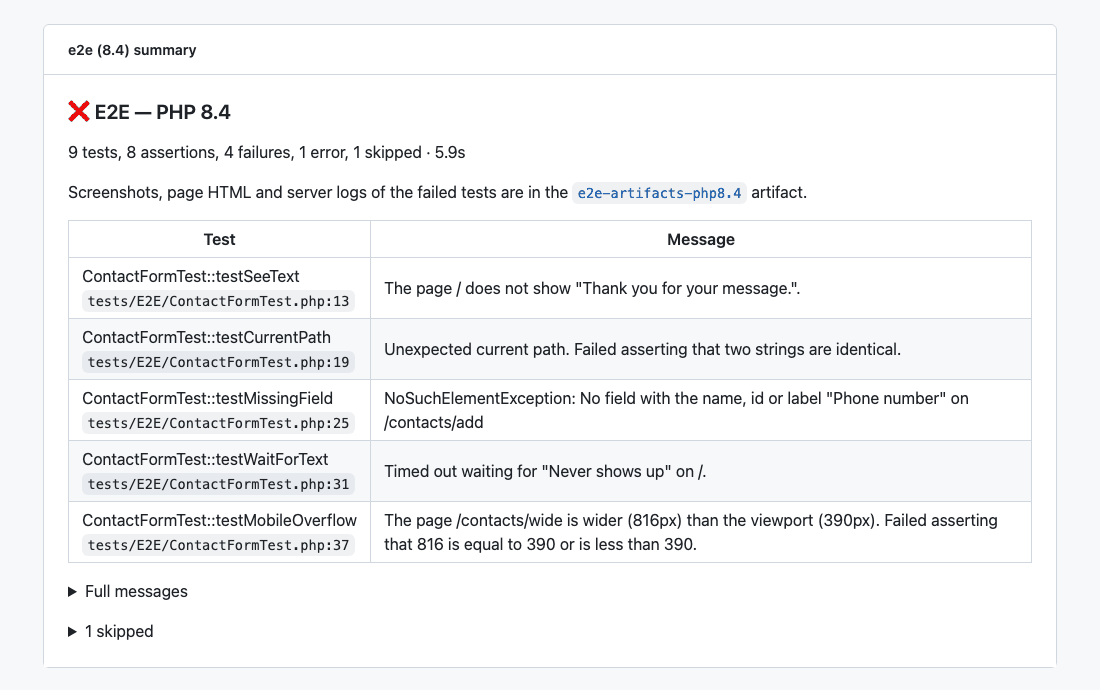
Use the same name as in the upload step. If the E2E job runs in a matrix, give each job its own artifact name, for example e2e-artifacts-php${{ matrix.php-version }}, in both steps.
Versions
@v1 follows the latest v1.x.y release of the action, which gets fixes and new optional inputs but no breaking changes. To pin an exact release, use @v1.0.0 or a commit SHA. See the ci-summary README for all inputs and for reports of other tools.
Jenkins
Jenkins is a continuous integration server, that can help you automate the running of your test cases. This helps ensure that all your tests stay passing and your application is always ready.
Integrating a CakePHP application with Jenkins is fairly straightforward. The following assumes you've already installed Jenkins on *nix system, and are able to administer it. You also know how to create jobs, and run builds. If you are unsure of any of these, refer to the Jenkins documentation.
Create a job
Start off by creating a job for your application, and connect your repository so that jenkins can access your code. Add a shell script step that installs the dependencies, including PHPUnit:
composer install --no-interactionAdd test database config
Using a separate database just for Jenkins is generally a good idea, as it stops bleed through and avoids a number of basic problems. Once you've created a new database in a database server that jenkins can access (usually localhost). Add a shell script step to the build that contains the following:
cat > config/database.php <<'DATABASE_PHP'
<?php
class DATABASE_CONFIG
{
    public $test = [
        'datasource' => 'Database/Mysql',
        'host' => 'localhost',
        'database' => 'jenkins_test',
        'login' => 'jenkins',
        'password' => 'cakephp_jenkins',
        'encoding' => 'utf8mb4',
    ];
}
DATABASE_PHPThis ensures that you'll always have the correct database configuration that Jenkins requires. Do the same for any other configuration files you need to. It's often a good idea to drop and re-create the database before each build as well. This insulates you from chained failures, where one broken build causes others to fail. Add another shell script step to the build that contains the following:
mysql -u jenkins -pcakephp_jenkins -e 'DROP DATABASE IF EXISTS jenkins_test; CREATE DATABASE jenkins_test';Add your tests
Add another shell script step to your build. In this step run the tests for your application. Creating a junit log file, or clover coverage is often a nice bonus, as it gives you a nice graphical view of your testing results:
vendor/bin/phpunit \
    --log-junit junit.xml \
--coverage-clover clover.xmlIf you use clover coverage, or the junit results, make sure to configure those in Jenkins as well. Failing to configure those steps will mean you won't see the results.
Run a build
You should be able to run a build now. Check the console output and make any necessary changes to get a passing build.